
Were Paleozoic Scorpions Aquatic?
Silurian Scorpions and a Possible Aquatic Lifestyle

Scorpions are known from fossils dating back to approximately 438 million years ago, in the Silurian period (Dunlop and Selden, 2013). They have thus existed on Earth since at least that time and have undergone remarkably little morphological change—hence they are sometimes referred to as “living fossils.” However, Paleozoic scorpions are thought to have possessed several features quite different from those of modern species.
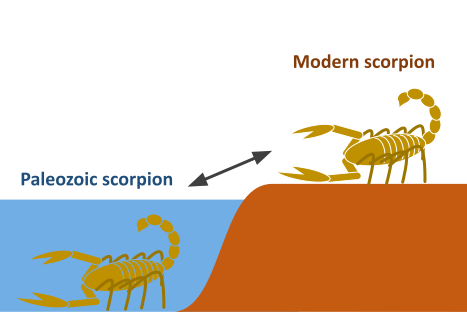
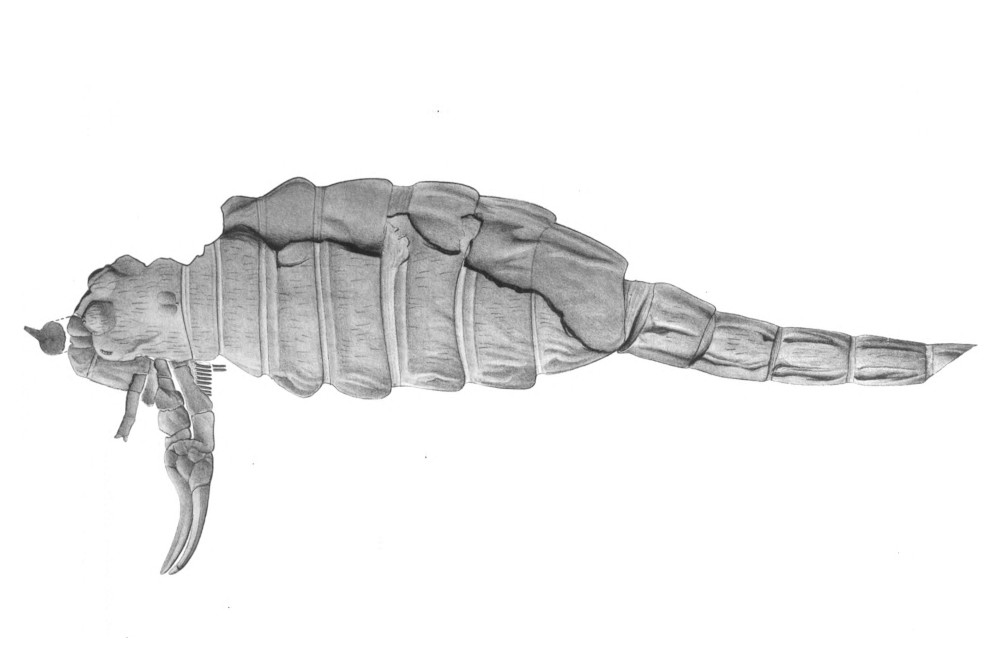
All extant scorpions are terrestrial, but during the Silurian Period it has been suggested that early scorpions may have been aquatic. This idea originated with the discovery, in 1882, of a fossil species named Proscorpius osborni from 418-million-year-old strata in central New York State, USA (Whitfield, 1885).
Evidence for an Aquatic Existence?
The hypothesis that P. osborni was aquatic is primarily based on two observations:
- No spiracles were observed on the fossil’s abdomen.
- The fossil was excavated from strata interpreted as a coastal environment that was submerged at the time (Whitfield, 1885).
Later interpretations even proposed that P. osborni possessed gills, and several other Paleozoic scorpion fossils were also described as potentially bearing gill-like structures.
Counterarguments to the Aquatic Hypothesis
However, not all researchers agree that Paleozoic scorpions were aquatic.
No unequivocal gill structures have been identified in any known scorpion fossils to date. Reexamination of P. osborni also suggested that the features once interpreted as gills do not constitute definitive evidence of such organs (Dunlop et al., 2008).
Furthermore, the site where P. osborni was discovered represented a coastal area during the Silurian Period, but it was not entirely submerged—there may have been exposed land, as fossilized terrestrial plants were also found nearby (Dunlop et al., 2008). Since some modern scorpions inhabit intertidal zones, it would not be surprising if P. osborni lived along the shoreline.
Even today, when scientists propose that a fossil scorpion was aquatic, the claim is typically based on indirect evidence—such as morphological traits suggesting adaptation to water or association with aquatic fossils—rather than on direct confirmation of respiratory structures (Waddington et al., 2015). So far, no fossil has yielded conclusive evidence of true gills.
References ▼
- Dunlop, J.A., & Selden, P.A. (2013). Scorpion fragments from the Silurian of Powys, Wales. Arachnology, 16(1), 27–32.
- Whitfield, R.P. (1885). On a fossil scorpion from the Silurian rocks of America. Bulletin of the American Museum of Natural History, 6, 181–190.
- Dunlop, J.A., Tetlie, O.E., & Prendini, L. (2008). Reinterpretation of the Silurian scorpion Proscorpius osborni (Whitfield): Integrating data from Palaeozoic and recent scorpions. Palaeontology, 51(2), 303–320.
- Waddington, J., Rudkin, D.M., & Dunlop, J.A. (2015). A new mid-Silurian aquatic scorpion—One step closer to land? Biology Letters, 11, 20140815.