Scorpion Life Cycle
Mating (Promenade à deux)
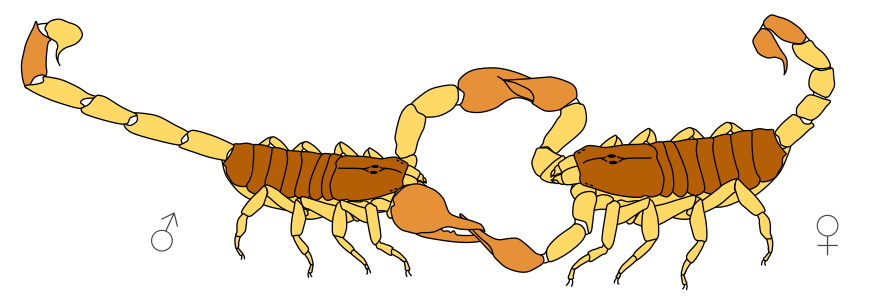
Scorpions do not mate by direct genital coupling in the manner of many arthropods. Instead, mating involves the male depositing a sperm-containing capsule, called a spermatophore, which the female subsequently accepts. The complex courtship sequence performed by the pair during spermatophore transfer is commonly known as the promenade à deux.
A typical sequence includes the following steps:
- The male and female face one another, and the male grasps the female’s pedipalps and leads her as he walks backward.
- If the female struggles, the male may restrain her by holding her chelicerae.
- The male uses his pectines to probe the substrate and, upon locating a suitable site, deposits a spermatophore from his genital opening onto the ground.
- The male then maneuvers the female so that her genital opening passes over the spermatophore; the female takes up the spermatophore and fertilization occurs internally (Rubio, 2008).
Birth and Parturition
Scorpions are viviparous: embryos develop inside the mother and she gives birth to live young rather than laying eggs. Gestation length varies widely among species, ranging from approximately two months to over 22 months (Lourenço, 2002). Members of the family Buthidae often have shorter gestation periods (commonly around five months), whereas other families may exhibit longer durations. For example, Pandinus imperator has an approximate gestation of seven months, Leiurus quinquestriatus about five months, and Isometrus maculatus around 2.5 months.
Prior to parturition, the female adopts a characteristic posture by raising the anterior portion of her body to create a space beneath her prosoma and mesosoma. She flexes the first and second pairs of legs inward to form a so-called "birth basket," which helps to receive the neonates as they are born. Young are born sequentially, and the mother typically maintains the birth-basket posture throughout the birthing process (Lourenço, 2002).
In most species a single mating event leads to a single subsequent pregnancy and birth. However, some species possess a spermatheca (a sperm-storage structure) that allows females to store sperm and produce multiple broods from a single insemination (Lourenço, 2002).
Growth and Molting
First-instar juveniles
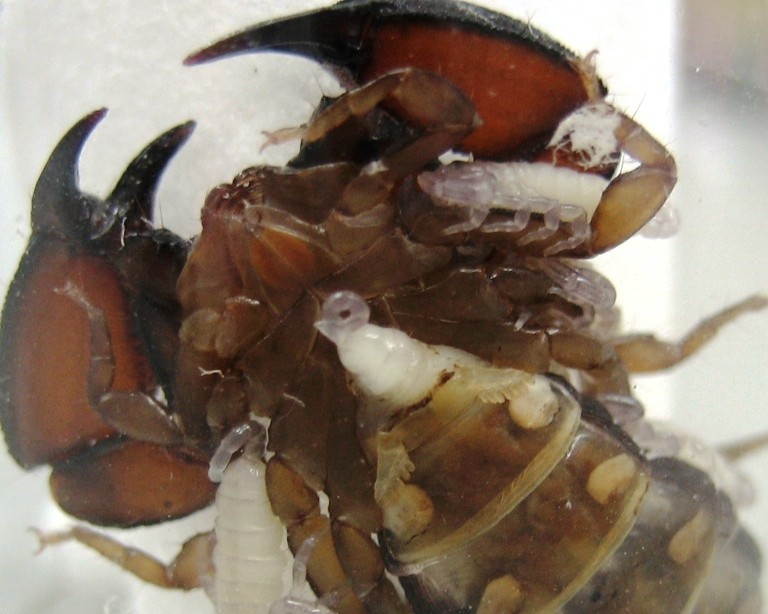
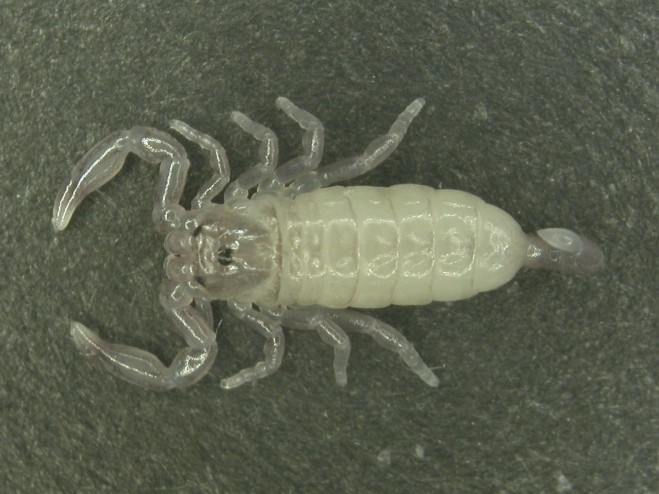
Because scorpions are viviparous, neonates resemble miniature adults. Litter sizes vary by species from only a few young to over a hundred in some cases (Lourenço, 2002), although intra-specific variation is often large and may depend on the mother's age and nutritional condition. For example, Liocheles australasiae may produce 20–30 young, while Isometrus maculatus typically yields 10–20 offspring.
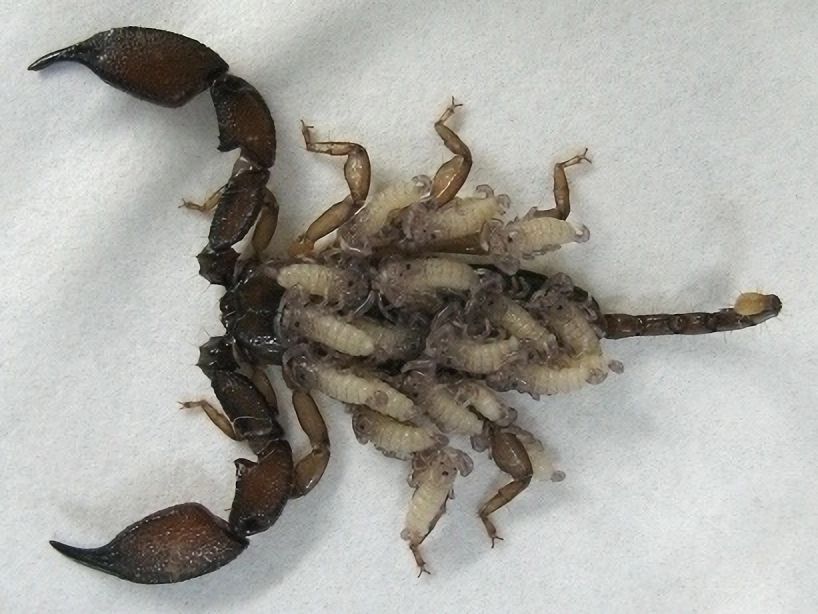
Newborn first-instar juveniles are more rounded than adults and lack fully developed claws on the tarsal tips. After birth, neonates climb onto the mother's dorsum and remain there while they undergo their first molt to the second instar; during this initial period they do not feed. Time to the first molt varies by species but is generally between about 5 and 25 days (Lourenço, 2002).
Subsequent molts and maturation
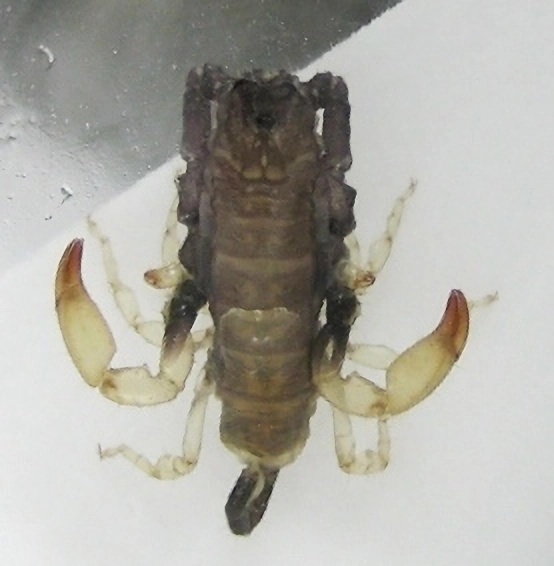
Juveniles molt repeatedly as they grow to adulthood. The duration of development and the number of molts (instars) vary by species. Observational records from captive breeding indicate that the time to maturity can range from roughly seven months to seven years, with four to nine molts occurring before adulthood (Lourenço, 2002).
Lifespan
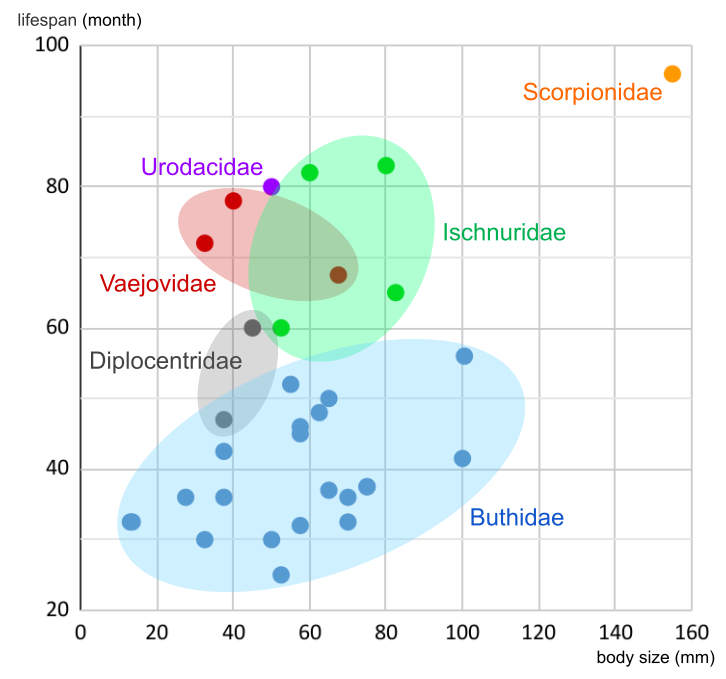
Postnatal lifespan varies among species. Many scorpions live between two and five years, although some species can live considerably longer; for instance, Hadrurus arizonensis has been reported to live up to 25 years under certain conditions (Polis, 1990).
Parthenogenesis
Overview of parthenogenesis
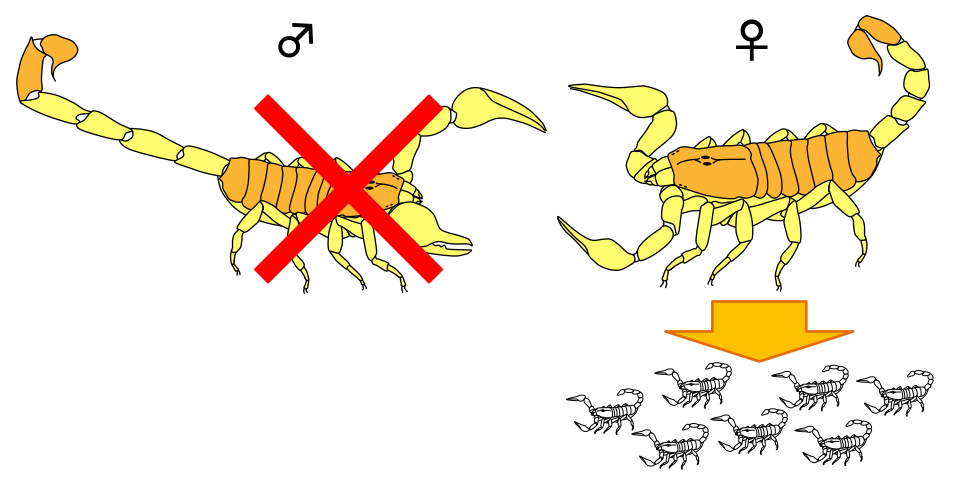
Some scorpion species are capable of parthenogenesis, whereby females produce offspring without fertilization by males. This phenomenon does not involve the use of stored sperm from a prior mating but rather the initiation of embryonic development in the absence of male gametes.
Ordinarily, gametes are produced by meiosis, yielding haploid cells; fertilization restores diploidy and initiates embryogenesis. In parthenogenetic species, alternative mechanisms restore diploidy or otherwise permit embryonic development to proceed without fertilization, resulting in viable offspring.
Parthenogenesis is well-documented among arthropods such as hymenopterans and hemipterans, and it has also been observed in several arachnid groups including mites, harvestmen, spiders, and scorpions (Francke, 2008). Most documented cases in scorpions are of thelytokous parthenogenesis (female-producing parthenogenesis), in which unfertilized females give rise to female offspring that, in turn, may reproduce parthenogenetically.
Scorpion species reported to exhibit parthenogenesis
To date, parthenogenesis has been reported in 19 scorpion species (Francke, 2008; Ayrey, 2017; Lourenço & Ythier, 2007; Lourenço & Cloudsley-Thompson, 2010; Lourenço et al., 2007; Michael, 2012; Seiter et al., 2016; Seiter & Stockmann, 2017). These species include:
- Buthidae
- Ananteris coineaui
- Centruroides gracilis
- Hottentotta caboverdensis
- Hottentotta hottentotta
- Lychas tricarinatus
- Pseudolychas ochraceus
- Tityopsis inexpectatus
- Tityus columbianus
- Tityus confluens
- Tityus metuendus
- Tityus neblina
- Tityus serrulatus
- Tityus stigmurus
- Tityus trivittatus
- Tityus uruguayensis
- Diplocentridae
- Cazierius asper
- Vaejovidae
- Serradigitus miscionei
- Vaejovis spinigerus
- Hormuridae
- Liocheles australasiae
Evidence and criteria for parthenogenesis
Parthenogenesis in the above species has been inferred or demonstrated based on four types of evidence:
- Population sex ratios are extremely skewed toward females or the population consists entirely of females.
- Females collected in the wild produce offspring without prior mating.
- Offspring produced are exclusively female.
- Virgin females reared in isolation in the laboratory (never in contact with males) produce offspring.
However, some caution is warranted: criteria (1) and (3) alone do not prove parthenogenesis (biased sampling or rare males may be overlooked), and criterion (2) may reflect the use of stored sperm in species capable of sperm storage. Consequently, among the 19 cited species, a subset remains uncertain with regard to true parthenogenesis.
References ▼
- Rubio, M.S. (2008). Scorpions: Everything About Purchase, Care, Feeding, and Housing (Complete Pet Owner’s Manual). Barron’s Educational Series.
- Lourenço, W.R. (2002). Reproduction in scorpions, with special reference to parthenogenesis. In European Arachnology 2000: Proceedings of the 19th European Colloquium of Arachnology (pp. 71–85).
- Polis, G.A. (Ed.) (1990). The Biology of Scorpions. Stanford University Press.
- Francke, O.F. (2008). A critical review of reports of parthenogenesis in scorpions (Arachnida). Revista Ibérica de Aracnología, 16, 93–104.
- Ayrey, R.F. (2017). Serradigitus miscionei, the first vaejovid scorpion to exhibit parthenogenesis. Euscorpius, 241, 1–7.
- Lourenço, W.R., & Ythier, E. (2007). Confirmation of reproduction by parthenogenesis in Hottentotta hottentotta (Fabricius) (Scorpiones, Buthidae). Acta Biologica Paranaense, 36(3–4), 213–217.
- Lourenço, W.R., & Cloudsley-Thompson, J.L. (2010). The life cycle of Tityus (Atreus) neblina Lourenço, 2008 (Scorpiones, Buthidae) in ‘Cerro de la Neblina’, Brazil/Venezuela. Boletín de la Sociedad Entomológica Aragonesa, 47, 293–298.
- Lourenço, W.R., Ythier, E., & Cloudsley-Thompson, J.L. (2007). Parthenogenesis in Hottentotta caboverdensis Lourenço & Ythier, 2006 (Scorpiones, Buthidae) from the Cape Verde Islands. Boletín de la Sociedad Entomológica Aragonesa, 41, 193–196.
- Michael, S. (2012). Developmental stages and reproductive biology in Tityus confluens Borelli, 1899 and Tityus ocelote (Francke & Stockwell, 1987) (Scorpiones, Buthidae). Revista Ibérica de Aracnología, 21, 113–118.
- Seiter, M., Schramm, F.D., & Barthel, A. (2016). The South African scorpion Pseudolychas ochraceus (Hirst, 1911) (Scorpiones: Buthidae) can reproduce by parthenogenesis. Journal of Arachnology, 44, 85–87.
- Seiter, M., & Stockmann, M. (2017). The life history of the parthenogenetic scorpion Lychas tricarinatus (Simon, 1884) from Odisha province, India and supplementary notes on Tityus trivittatus Kraepelin, 1898 (Scorpiones, Buthidae). Zoologischer Anzeiger, 270, 155–165.